
Twenty years of buying taught me what actually mattered. Now that we're the ones being hired, it's the bar we try to clear.

I spent twenty years hiring consultants. I sat through the polished decks, approved the statements of work, and picked the impressive logo over the right team more than once. I got plenty of it wrong.

What I learned in all that buying is now the thing we're built around. So this is not a list of what consultants get wrong. It is what I learned to look for as a buyer, and, now that Domino is the one being hired, the bar we try to clear. Where we fall short of it, I would rather you know what to hold us to.


The senior person on the slide

Every pitch has the senior partner's face on a slide. Twenty years of experience, deeply involved, subject-matter expert. Two weeks in, they are on another project and the work is being done by someone who graduated last year.

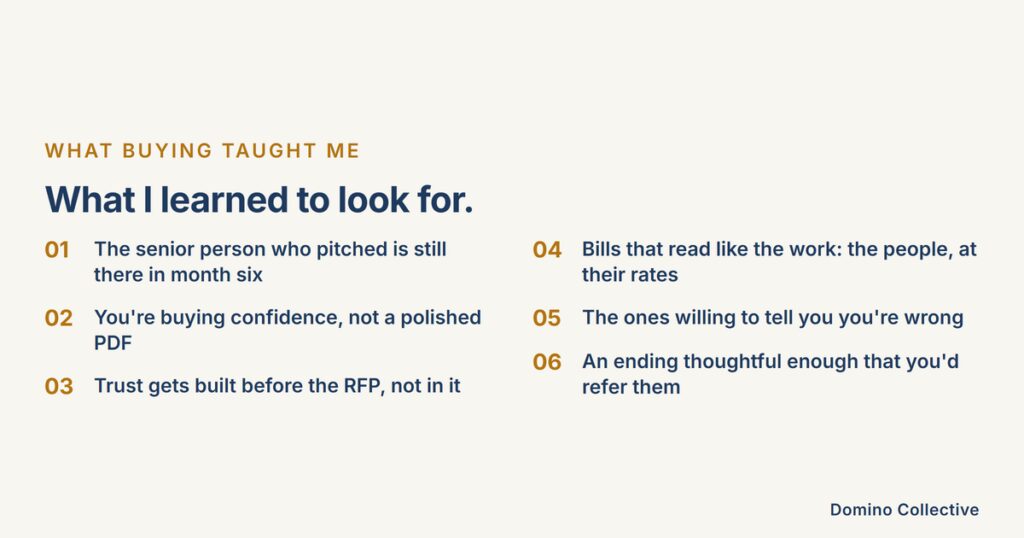
I stopped believing the slide. What I learned to look for instead was whether the person who sold me the work would still be in the room in month six, when a hard decision needed making. That is easy for us to promise today, because we are small: the person who pitches you is the person who builds. It gets harder to hold as a firm grows. So hold us to it as we grow.
You’re buying confidence, not deliverables
I was never really buying the roadmap document or the ninety-day plan. I was buying the confidence to make good decisions after the consultants left. That confidence came from working through hard problems alongside people who were good at them. It did not come from a polished PDF at the end.
So we build the work around the working sessions, not the artifact. The document is a record. The confidence is the point.
Trust gets built before the RFP
Here is something buying taught me that selling has only confirmed: the RFP is rarely where the decision actually gets made. It gets made months earlier, in who was genuinely useful before there was a contract on the table.
We are on the selling side now, and we respond to RFPs like everyone else. But we would rather earn a place in the conversation by being helpful early than win one on paperwork. If we ever show up only when there is a document to fill in, we have missed the point.
The unglamorous things that actually mattered
The things that quietly wrecked engagements for me were rarely dramatic. It was the person I trusted getting rotated off “for their development.” It was a bill I could not read without flinching: junior work at senior rates, “engagement management” stacked on top of a project manager on top of an account director. Small things, but they told me how a firm really thought about me.
So we do not rotate people off to plug a gap somewhere else, and our bills read like the work: the people doing it, at their rates. When we are big enough that rotation is tempting and padding is easy, those are the two places to watch us hardest.
The ones who told me I was wrong.
The consultants I kept hiring were the ones willing to say “I think you’re wrong about this, and here’s why.” Not for sport. Honestly, in a way that made me want to hear the reasoning even when I disagreed with the conclusion.
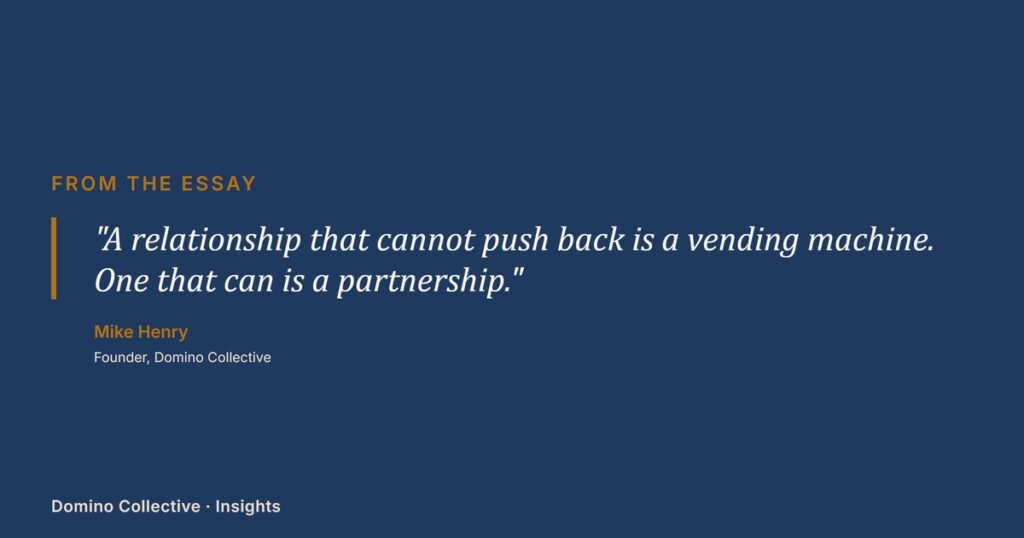
Most firms will not do this, because they are afraid of losing the work. So they agree, deliver exactly what was asked, and watch the engagement fail six months later because the problem we thought we had was not the real one. A relationship that cannot push back is a vending machine. One that can is a partnership. We would rather be the second kind, even when it costs us the easy yes.
How it ends is what I remember
I remember how every engagement ended. The firms that wound down thoughtfully, stayed reachable for the small follow-up questions, and checked in a year later, I still refer them. The ones that vanished the day the last invoice cleared, I remember that too, and I do not.
A good ending is the cheapest, most durable marketing there is. So we try to leave the way I wish firms had left me.
Hold us to it
None of this is revolutionary. It is just the stuff I cared about as a buyer, turned into how we try to work. We write proposals. We respond to RFPs. We are going to get things wrong. So hold us to all of it. If we rotate the senior person off, pad a bill, tell you only what you want to hear, or disappear at the end, call it. I wrote it down on purpose.
If any of this rings true from an engagement you have been part of, on either side of the table, I would be glad to hear which part. The thirty-minute conversation is open. No proposal attached.
About this piece

*This is the second essay in a monthly Insights series on data, capability building, and what real engagements teach us. The first introduced the five dominos framework. The next, from our engineering team, is on the data-modeling approach that keeps paying off long after the build is done.*

*Mike Henry is the founder of Domino Collective, a Calgary-based data and technology partner. He spent twenty years on the buyer side of enterprise technology and data before starting the firm.*


