
I gave AI agents real jobs inside my own company: not a chatbot on the website, but actual work that used to land on a person. One writes our marketing, one runs my calendar and my inbox, one handles the paperwork side of hiring, one helps with our code, and one watches the other four. There are five of them now, and this is the story of how that happened, and what it took to make it safe enough that I actually trust it.
I want to be honest about the start, because it was not a plan. I did not set out to build a team of AI agents. I set out to fix a website.
It started as a website problem
Years ago, in the early days of the company, I put up a website in a hurry because I needed one to qualify as a technology partner. The story on it was the company I thought I was going to build. Then a couple of years went by, and we became something more specific than that first draft. We worked out who we actually are in the day-to-day work with clients, not in a strategy session. One day I stopped and asked myself a simple question: who are we now? I went to our own website to read it back, and it wasn’t there. The things I care about most, the way we work with people and the culture around a change, were nowhere on the page.
So I built one thing to fix that one problem. I made an AI agent that read back how we actually talk, in our own emails and meetings and documents, pulled out the themes we kept returning to, and then measured how far all of that had drifted from what the website was saying. The two were a long way apart. That agent was the first one I built, and I called it Miles.
Here is the part I didn’t see coming. Fixing that one problem showed me the next one. With the writing handled, I started noticing how much of the rest of my job had the same shape: work that kept falling on me because I was the only one holding it. So I built something for the next job, and then the one after that. I never sat down to design a team. I added one agent at a time, each for a real problem.
The five, and what each one does
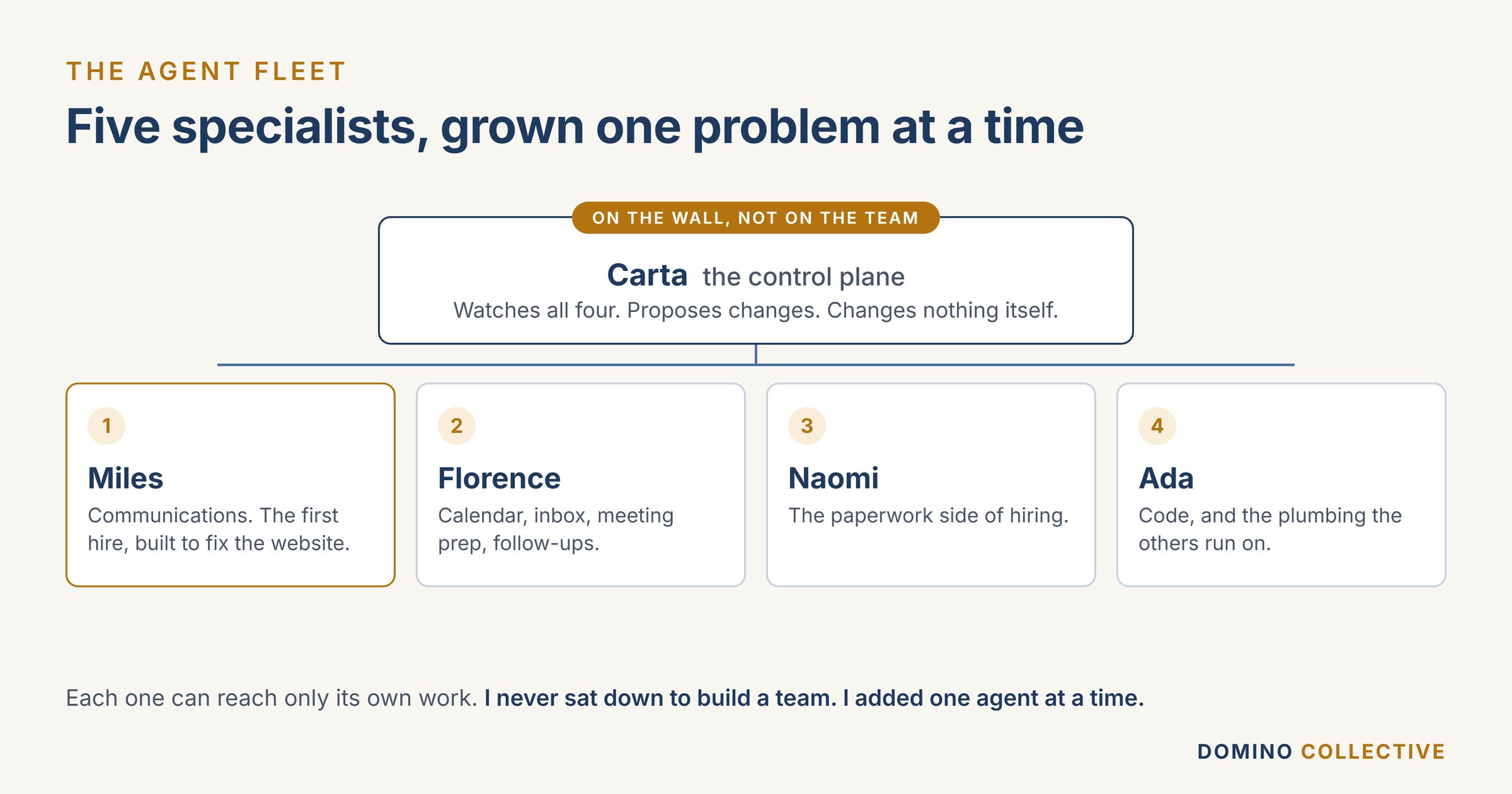
- Miles runs our communication and marketing: how we sound, how we look, and what we publish.
- Florence runs the day-to-day around me: my calendar, my inbox, getting me ready for meetings, chasing the follow-ups that used to go cold.
- Naomi handles the paperwork side of hiring: who applied, what stage they are at, what still needs doing.
- Ada is the technical one. It reads our code, weighs up how something should be built, and looks after the plumbing the others run on.
- Carta is the odd one out, and I will come back to it, because it does not have a job like the others. Its job is to keep the other four honest.
Why five narrow agents instead of one that does everything
The obvious thing to build is a single, capable assistant that does a bit of all of it. One thing to set up, one thing to talk to. I did the opposite, and there are two reasons.
The first is safety, and it is simpler than it sounds. An agent that only works on our marketing has no way to reach our hiring records, so it cannot make a mess of them, even by accident. Think of how access already works with people. When someone new joins, you give them a key to their own office and the files they need, not a master key to the whole building. The agents are the same. Each one can reach only the things its own job needs. I don’t have to trust the marketing agent to stay away from the hiring files. It was never given a way in.
I don’t have to trust the marketing agent to stay away from the hiring files. It was never given a way in.
The second reason is that the work is simply better. An agent that does one job, knows one set of things, and speaks in one voice does that job better than a jack-of-all-trades stretched across everything. Miles sounds like us because sounding like us is the only thing it does.
How they work together without stepping on each other
The risk with five separate specialists is that you end up with five clever tools that cannot work as a team. So the important part is how they hand work to each other, and a real example shows it best.
A resume lands in my inbox. Florence, who runs my inbox, has exactly one job with it: save the resume into a folder for that candidate so it doesn’t get lost, and then stop. It does not start ranking the candidate or building a hiring tracker or writing back. All of that is Naomi’s job. So Florence saves the file and tells Naomi it is there.
That restraint is what keeps it safe, and the access is drawn just as narrowly. Neither agent runs the other’s domain. The only crossing point is one candidate folder: Florence can drop a resume into it and do nothing else in Naomi’s world, and Naomi has no way into my inbox at all. What passes between them is a short message, “new candidate, here is the resume,” pointing at the file. That is exactly what Naomi needs for the next step, and nothing else. Naomi never needs the run of my inbox, because the one thing it needed was handed straight to it.
It reads like a small detail, but it is the heart of the design. The agents do not share one big pile of everything that they all reach into. Each hand-off carries only what the next agent needs, one thing at a time: a pointer to the file, not a key to the room it came from. So if one of them makes a mistake, or is fed a bad instruction, it cannot spread to the others. There is no shared pot for it to spread through, and no borrowed access riding along with the message.
The one that keeps the others honest
That brings me back to Carta, the fifth one. Once you have four agents with real access to real systems, you need something watching the whole picture: making sure two of them have not ended up able to reach the same sensitive thing, that a rule for one does not contradict a rule for another, that nothing important is sitting in a gap that nobody owns. That is Carta’s job.
I made the mistake of calling it a colleague once, and it corrected me. It does not have work of its own. It has no inbox and nothing to deliver. It watches, and it flags, and it proposes fixes, but it is not allowed to change anything itself. The way I think about it now is that Carta belongs on the wall, like a fire alarm, not on the team. It watches everything, detects danger, but touches nothing.
That distinction turns out to matter more than almost anything else in how the whole system is kept safe, and it is where the next article goes, because every one of these agents runs with real access to real systems.
So the questions I had to answer, before I would trust any of it, were these three: when an agent acts, who is it? What is it actually allowed to touch? And if something went wrong, could I go back and see what it did? That is the next article, and it is the one that decides whether any of this belongs in a serious business.


